View of Endon.

View of Endon.
View of Endon.

Friday, 17 July 2015

Are there any glow-worms along the disused railway line?

Glow-worms are the female counterpart of a species of bioluminescent beetle.  there are three British species. The female's light, which shines green at night, helps her attract a male and deter predators http://www.bbc.co.uk/naturestop40/ep1/s38.shtml. Their larvae feed on snails and slugs, of which there are plenty on the disused railway line between Endon and Leek; the limestone ballast provides a source of calcium to build mollusc shells. Glow-worms have been seen on the railway line near Park Lane in the past, so I though I would have a look to see if there are any still there. So, on the evening of 15th July we went for an evening walk along the railway line to look for glow-worms lights. We didn't see any, but it was a lovely walk in any case. Here are some photos with captions telling of what we did see, smell, and hear.

Plenty of wild flowers. In this picture Rosebay willowherb, Hogweed, Meadowsweet and dock. 

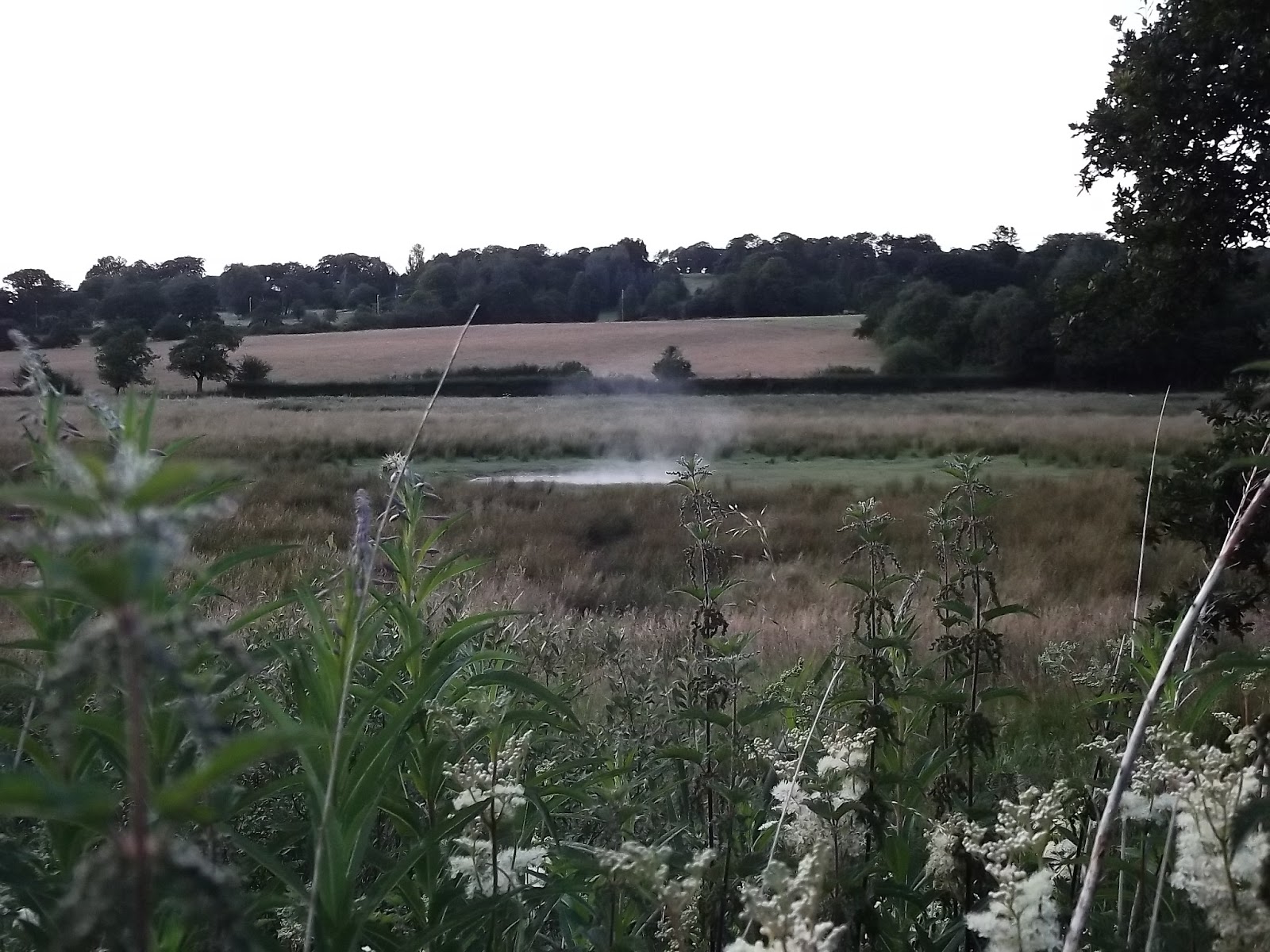
Mist rising from pools, the canal and Endon Brook as the evening sky cooled down to dew point. A Grasshopper Warbler was singing near here, as it has been for the last month.

Profusely flowering Honeysuckle emitting a powerful and geourgeous scent. We didn't notice any moths around here at that time, however we did see bats which would undoubtedly be feeding on on moths that would be attracted to the nectar of the honeysuckle flowers. 

Wednesday, 15 July 2015

Canal and River Trust response.

After about six months of me pestering them I finally got the Canal and River Trust to address my concerns as to how they are managing the Caldon Canal with regard to its natural assets. Here is the letter that Perter Birch has sent me following my meeting with him and Darren Green (Manager of Central Shires Waterways). Judging by what was said during our meeting and this letter they appear to have admitted that they are not paying proper attention to how they care for the wildife on the canal. They say they sill do better in future. I don't have much conficdence that that will actually happen, but we'll see. Photos with captions describing what they get wrong are below the letter.

13th July 2015


Dear Wendy

Caldon wildLife

Many thanks for taking the time to meet Darren and I on site on 30th June. We both felt it was a good opportunity to talk through the matters that were concerning you regarding the recent dredging work on the Caldon Canal. Through our discussions a number of areas were identified where we agreed that we could take action, which will include some revisions to our current practices as well as some local specific actions to deal with the issues you raised.

With reference to our conversation, I believe the following are a summary of the agreed actions:

  1. I will ask my team to review the silt deposit at the winding hole and look for ways to reinstate wetland habitat at this location or somewhere else on this section of the Canal;
  2. We will also draw up proposals for improving the water’s edge interface on the Nicospan disposal area at Baddeley Green;
  3. We will review the specification for grass cutting at the back of the towpath adjacent to the former Thomas Bolton works in Froghall, to improve the protection for the orchids that are present there;
  4. I’ll provide an example of where netting vegetation, prior to clearance to prevent bird nesting, has been carried out for your comments on the method;
  5. We are already working on the Japanese Knotweed issue with Staffordshire Council and their contractor – I will provide an update on how this is being dealt with;
  6. Darren will investigate the reason for the extensive spraying around the weir overflow close to Endon Road that we passed returning from our meeting on site and either provide a good explanation as to why this cannot be cut instead, or change the standard applied there;
We recognise how important and essential it is to have passionate local people working with us to manage this valuable environment for all to enjoy. Our meeting illustrated the benefit of having local people, such as yourself, looking at the work we have done and how we have gone about it, and providing critical feedback. As we discussed we would be really grateful if you would provide some further local knowledge in terms of areas where you or others have spotted rare or special species where we should be taking particular care or sites where we can relax or improve our vegetation management to create better habitats for the wildlife on the Caldon. Once we receive them, we will review these suggestions and let you know what can be done to improve the situation.

Once again, many thanks for your time and for sharing your views and ideas.

Yours sincerely


Peter Birch
National Environment Manager

T: 07860 737763

The Winding Hole before the CRT dumped dredgings on to it.....

...and here after the CRT dumped dredgings on to it, in spite of this action being in contradiction to prescriptions in an ecological study prepared for Staffs County Council as part of their preparations before they installed the Pedal2Peak cycle path.


Bank reprofiling on the canal at Baddeley Green was caried out at the end of 2014. See below for details. 

Bank reprofiling on the Caldon Canal at Baddeley Green was carried out is such a way as to make several hundred metres of canal hostile to much of the wildlife that uses reed fringes. The vertical nicospan edging has been positioned so that it is above the water level, even though the CRT's own rules say it should be 10cm below the water level. 

Japanese Knotweed has been spread along the canal by Staffordshire County Council during the cotstruction of Pedal2Peak. The CRT are aware of this but still send contractors out to strim the pathside vegetation, thus potentially spreading this pernicious weed to more places!!

Broad-leaved Helleborine growing alongside the towpath at Froghall which the CRT say they will now desist from strimming. 

An example of herbicide use by CRT. This is both unsightly and potentially against Environment Agency guidelines which require special conditions to be met before weedkiller can be applied within 1m of a water body. 

Thursday, 2 July 2015

Hedges in Endon.

Some good....
Wild life garden hedge - in July full of flowers which provide food for invertebrates which in turn are food birds etc.

Thick hedge with holly berries (between Endon and Brown Edge).

Hedgerow with mature trees between Church Lane and Holehouse Lane - Endon.

And some bad....
Flailed hedge (along A53 through Endon).
Gappy, trampled and browzed hedge between Endon and Brown Edge. The trees and shrubs may become so badly damaged by livestock that they die and the hedge disappears altogether.

Another closely clipped hedge (off Tomkin Road) - no possibility of flowers in warm seasons or fruit in cold. Offers less value to wildlife.

And then the four photos below show Gratton Lane on July 7th 2015, where, for some ill-judged reason, someone decided to apply weedkiller. Among the wildlflowers that are left dead and dying are: Greater stitchwort, Foxgloves, Common Nettles, Wood Sorrel, various grasses, Hogweed, Garlic Mustard etc. etc. WHY??? I wonder?


Wednesday, 1 July 2015

Bee Hotels in my garden.

The current spate of hot dry weather is bringing out the hole-nesting bees and wasps. I saw at least five species of bee or wasp using the bee hotels in my garden today. Including: definately one of the Cuckooo Wasps (Chrisis sp.); probably an Andrena sp. bee; an Ancistricerus sp. (a potter wasp); plus others. But the most impressive was the Gasteruption sp. cleptoparasitic (or cuckoo) wasp which has a very long ovipositor which she uses to lay her eggs in the open nests of the mason bees. I watched them flying in front of the nest holes, choose a hole to lay eggs in then reverse up and manipulate her ovipositor in order that tt is removed from its protective outer sheath. She then inserts her ovipositor and lays an egg. Sometimes she backs her whole body in to the hole. When she comes out the wasps can be seen cleaning their ovipositor with their legs. They are difficult to photograph because the don't stay still for very long! When their eggs hatch the larvae feed on the provisions, pollen and nectar, that were placed in the nest by the host species; and they may eat the host speceis larva too! A grisly way of life perhaps, but nevertheless fasinating.

One of my bee hotels with some holes used by bees last year. The capped ones are individuals haven't emerged yet. While some of the nests have small holes that could be either where the original occupant has emerged or its patrasitoid has come out, or even where a predator has broken in. The debris below the log is where bees have started clearing the holes for using this year. 

Possibly and Andrena sp. of mason bee making its nest.

Mason bee again....

and again. This photo shows the hairy underside which is used to trap and hence transport pollen by this species of bee. The males do not have this as they do not play any part in constructing and provisioning the nests. In contrast, several photos down is a relatively hairless bee, one of the Hylaeus sp. 

One of the Gasteruption sp. of mason bee parasitoids investigating a nest hole and a mason bee building a nest in another hole.

The Gasteruption again. 

 A green and red Cuckoo Wasp, perhaps Chrisis ignata, serching for mason bee nests in which to lay her eggs. Cuckoo Wasps are parasitoids of Mason Bees. they lay their eggs in the nests of the Mason  Bees. The Cuckoo Bee's eggs hatch and the subsequent larva feds on the Mason Bee larva and the food that has been placed in the nest by the mother Mason Bee for her young. hence the name Cuckoo Wasp!

An unidentified wasp or bee visiting the bee hotel. 

Probably an Ancistricerus sp. of wasp. investigating a hole. Also called Potter Wasps.

This is probably one of the several Hylaeus species of bee. They are also called Yellow-faced Bees as they often have yellow or white markings on their faces. this one does not appear to have those but it does have yellowish tibia (the equivalent would be calves on humans) on at least its middle and back legs. These bees line and cap their nests with a cellophane-like substance which I assume is derived from plant tissue and their own saliva. It creates a translucent finish to the nest cap. These bees have relatively hair free legs and undersides hence, unlike most other species of bee, which carry pollen within specialised hairs on their legs, undersides or other parts of their bodies, these bees transport pollen and nectar within their digestive tract. 

The cellophane-like nest caps of Hylaeus cells. 

Other capped cells in my bee hotel. 


Sunday, 14 June 2015

Walk from home to Deep Hayes Country Park.

After a morning of constant, but very welcome rain, we went for a walk along the Caldon Canal to Deep Hayes Country Park. This year there are a few new additions to the canalside flora, and one chance observation resulted in identifying an overlooked species in a familiar location - see photos below. Also, some bird and mammal sightings.

Two Brown Hares in a field adjacent to Caldon Canal between Post Lane, Endon and Park Lane.

Mimulus gutatus or Monkeyflower growing on the offside of Caldon Canal between Post Lane, Endon and Park Lane. According to Simon Harrop in Harrop's Wild Flowers (Bloombsbury 21013) this is a non-native species that was introduced to Britain from N. Amer. in 1918 and first seen in the wild in 1924. This year is the first I have spotted it growing on the Caldon Canal in Endon. The seeds probably came in with a narrow boat or via transported by the water itself.

Mallard duck with several few days-old ducklings by Park lane, Endon.

One of a pair of Moorhen parents who had one fluffy chick, which isn't visible in this photo. This species regularly breeds at this point on the canal.


Yellow Flag Iris was growing along the canal between Endon and Stockton Brook, however at this site between Park lane and Hazelhurst Junction it is a new addition. I assume it was planted in the coir rolls that were used by Staffordshire County Council during their installation of the cycle path on the former canal towpath in 2013/14, as it appeared following that work.

A Reed Bunting was singing in the reed bed (Phragmites sp.) in the midground of this photo which was taken near Hazelhurst Junction. The dead vegetation  in the foreground is Japanese Knotweed, the invasive non-native species, which has been sprayed by contractors for the Canal and River Trust. Also along here a Garden Warbler was singing, and Chiffchaffs,  Common Whitethroats, Sedge Warblers, Blackcaps and Willow Warblers were heard nearby... and two male Bullfinches (below) too.


Swallows were plucking freshly emerged insects from above the canal surface along this stretch of the Caldon Canal, near H. Junct.. 

Two photos of the recently fledged Swallows below. 


Wood Melick a "common grass of woods and shady banks" according to Hubble in his classic "Grasses" (Penguin books 1954 - 1984) - Here growing in Deep Hayes Country Park. 

This photo, and the one below it, are of Bay Willows Salix pentandra in flower. Though I have seen these plants, which are located in the Winding Hole between Park lane and Hazelhurst Junction, many times, I hadn't particularly noticed what species they are. Today they were exhibiting a beautiful display of male flowers. This is a native species of willow and I have seen other plants of this speceis along te disused railway line at Cheddleton and in Stanley Moss (between Endon and Stockton Brook). 
 

On the way back from Park Lane we walked along the disused railway, which was sprayed with weedkiller by the Churnet Valley Railway (CVR) volunteers this week. The CVR still have unrealistic plans to reopen this railway line and so continue to glyphosate the trackbed every year. This has mixed results. On the one hand it kills off some of the wild flowers that grow along the railway route, on the other it prevents the build up of vegetation on parts of the ballast, thereby creating open space (useful habitat for many invertebrates and basking adders, which have been seen along there) and helps reduce soil nutrient build up which can result in reduced wild flower species diversity (rich soil benefits vigorous species which smother weaker/smaller species) . Anyway two species that have avoided the best efforts of the CVR volunteers are the Fox and Cubs Pilocella aurantiaca (photo below) another naturalised, introduced species (from 1629), and .......


...Bistort Persicaria bistorta (below). A relative of the Japanese Knotweed mentioned above. It is a native species that often grows in the wild due to garden throw-outs. This patch is growing along the disused railway line, and I've not noticed it before 


And finally, a mixed-age group of Lesser Black-backed Gulls seen feeding from the railway line in a field near Post Lane/Station Road. This flock is a regular sighting at present. And just before we came upon these birds heard the two Oystercatchers which seem to hang around Endon, often on the pool in the grounds of The Ashes wedding venue.




Saturday, 13 June 2015

Swifts in Endon.

Endon has at least  two nest sites for Swifts; one is the roof of Alder House (where the local pharmacy is), the other is my street. Here is a couple of photos of a Swift entering the wall cavity via a broken air vent on the side of the house of one of my neighbours. On Tuesday, while I was carrying out the late season visit to the nearby (about 6km) Ford Green Hall Nature Reserve for the British Trust for Ornithology's Breeding Bird Survey I saw tens (possibly around 100) of Swifts feeding over the pool, along with a few House Martins. Presumably there had been a mass emergence of some species of aquatic invertebrate. We see about eight Swifts flying around Endon. Does this mean there are four pairs breeding in our village? I'm not sure.